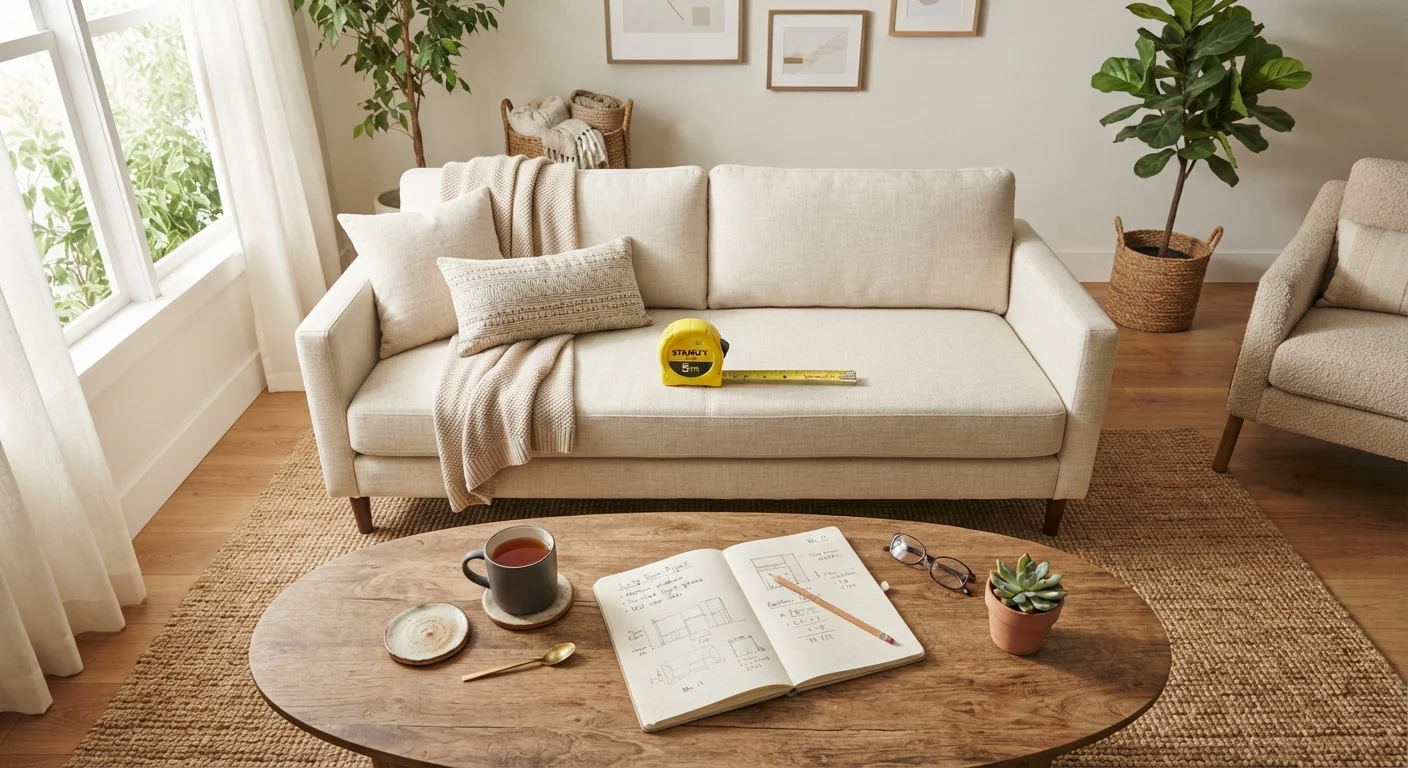
Work through each room systematically with this checklist covering condition, scale, arrangement, and styling before you spend a dollar.
Key Takeaways
Check structural condition before deciding whether to replace, refinish, or keep any piece.
Scale mismatches between furniture and room dimensions are one of the most common and fixable problems.
Rearranging what you already own can resolve most flow and focal-point issues without spending anything.
Work room by room so findings in one space inform decisions in the next.
Styling choices should come last, after condition and layout are resolved.
How to use this checklist
Work through one room at a time, ideally with a notepad and a tape measure in hand. The checklist is split into four categories that apply to every room: condition, scale, arrangement, and styling. Completing them in that order matters because a piece with a cracked joint or delaminating veneer should be assessed for repair or removal before you decide where to position it.
You do not need to act on every finding immediately. The goal of the audit is to document what each room actually needs so you can prioritize.
Condition
Inspect every joint, leg, and drawer slide for wobble, cracks, or signs of failure. Note which pieces need structural repair before they are safe to use.Must
Check upholstered surfaces for tears, staining, or compressed foam that no longer recovers. Determine whether reupholstering is practical given the frame's condition.Must
Look at all wood and laminate surfaces for deep gouges, water rings, or peeling veneer that a simple clean will not fix.Must
Test every hardware item: drawer pulls, hinges, casters, and lid supports. Replace broken hardware before the audit moves to layout.Should
Note any pieces that smell of mildew or have visible mold. These require cleaning with appropriate products or removal before the room is used.Must
Scale and proportion
Measure the room's length and width, then compare those figures against the footprint each furniture group occupies. A seating area should not cover more than two-thirds of the usable floor area.Must
Check seat heights against the tables they pair with. A dining chair seat should sit roughly 10 to 12 inches below the tabletop surface.Should
Stand at each doorway and confirm that no single piece visually blocks the room's natural focal point, such as a fireplace, window, or architectural feature.Should
Verify that tall storage pieces do not overwhelm walls shorter than 9 feet. In lower-ceilinged rooms, horizontal storage usually reads better than vertical.Nice to have
Check that the visual weight of pieces is balanced across the room: avoid clustering all large, dark items on one side.Should
Arrangement and flow
Walk every path between entry points and confirm at least 36 inches of clearance for primary traffic routes, and at least 18 inches between secondary pieces.Must
Confirm that seating faces or angles toward the room's focal point rather than toward blank walls or doorways.Should
Check that conversation groupings keep seats within roughly 8 feet of each other so occupants can speak without raising their voices.Should
In bedrooms, verify that you can open every drawer and door fully without obstruction, and that both sides of the bed have workable clearance.Must
For a complete pre-decorating review, also audit natural light paths: furniture placed directly in front of a window blocks light the room needs.Should
Styling and finish
Identify the dominant finish tone in the room (warm, cool, or neutral) and flag any pieces whose finish clashes rather than contrasts intentionally.Should
Check that textiles (cushions, throws, rugs) are in usable condition and that their scale is appropriate: a rug should anchor the main seating group, not float beneath only the coffee table.Should
Furniture Editorial Team is the collective byline for our editorial team and contributor network. Articles published under this byline or an editorial pen name are researched, written, and reviewed according to our editorial standards for clarity, consistency, and independence before publication.
The content provided on our blog site traverses numerous categories, offering readers valuable and practical information. Readers can use the editorial team’s research and data to gain more insights into their topics of interest. However, they are requested not to treat the articles as conclusive. The website team cannot be held responsible for differences in data or inaccuracies found across other platforms. Please also note that the site might also miss out on various schemes and offers available that the readers may find more beneficial than the ones we cover.