

Solid Wood vs. Engineered Wood: What the Difference Means for Your Home

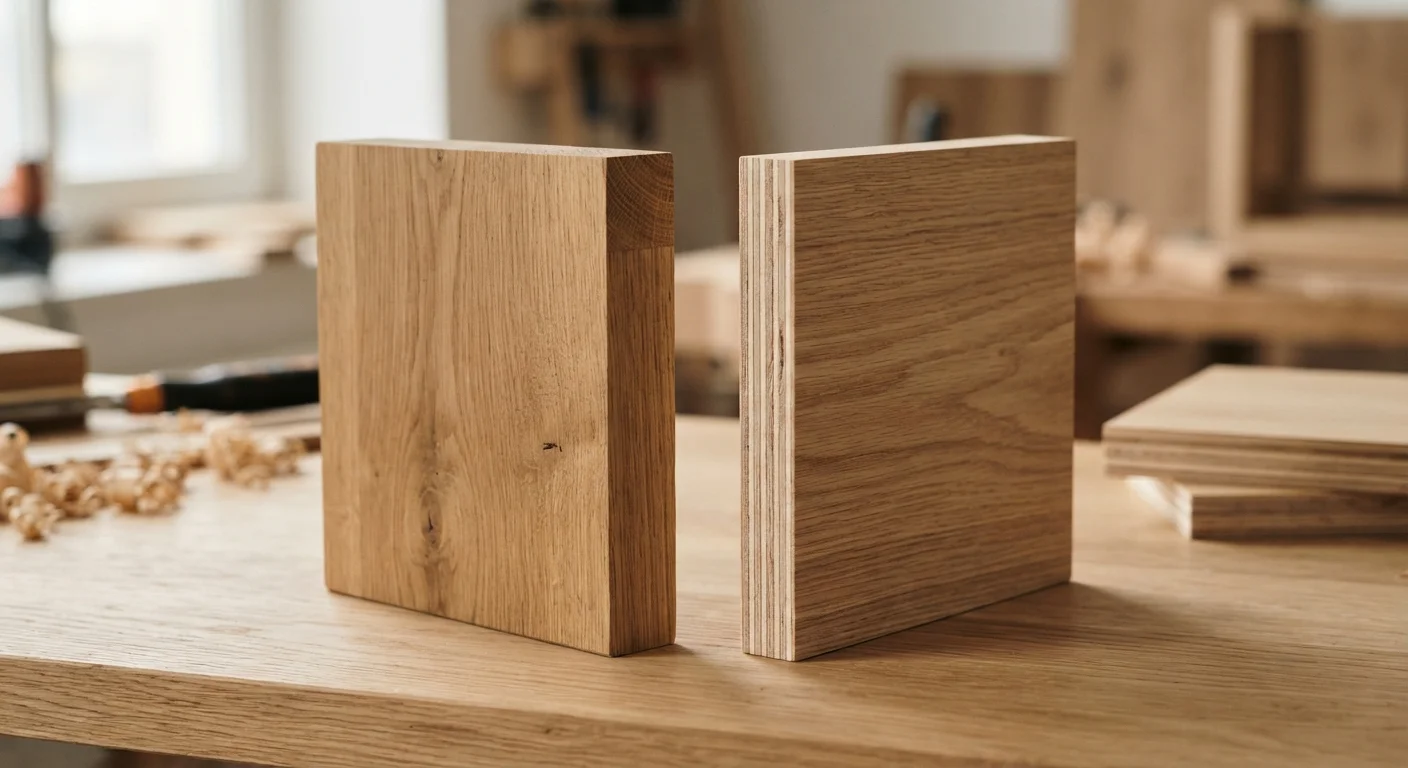
Photo: signaturehomeideas.com editorial
Key Takeaways
- Solid wood is cut from a single species and can be sanded and refinished multiple times over its lifespan.
- Engineered wood products such as plywood, MDF, and particleboard vary widely in density, strength, and moisture resistance.
- Moisture and temperature swings cause solid wood to expand and contract, which can crack joints in unstable environments.
- Engineered wood typically costs less up front but is harder to repair once the surface layer is damaged.
- The right choice depends on the room, expected use, and how long you plan to keep the piece.
How each material is made
Solid wood comes directly from a log: the lumber is milled, dried, and shaped without bonding agents or core layers. What you see on the surface runs all the way through the board. Common species used in furniture include oak, maple, walnut, and pine, each with its own density and grain character.
Engineered wood is a category, not a single product. Plywood stacks thin wood veneers with alternating grain directions, which distributes stress evenly and resists warping. Medium-density fiberboard (MDF) is ground wood fiber compressed with resin into a smooth, uniform panel. Particleboard uses coarser wood chips and is the lightest and least dense of the three. Oriented strand board (OSB) bonds large wood strands in perpendicular layers and is used mostly in construction rather than furniture.
Reading furniture labels accurately
Furniture labeled "wood" without further detail may use any combination of these materials. Checking the product specification or examining the edges and underside of a piece tells you what the core actually is.
Durability and repairability
Solid wood tolerates wear well over time. Scratches and dents sit only in the surface layer, so a light sanding followed by a fresh finish restores the look. Deep gouges can be filled with wood filler matched to the species. The material itself does not delaminate or bubble.
Engineered wood durability depends on which product you have. A well-made plywood cabinet can last as long as a solid wood one under normal conditions. MDF is dense and machines cleanly, but it swells permanently if water penetrates the surface coating. Particleboard is the most susceptible to moisture and to edge damage from repeated use. Once the veneer or laminate on an engineered panel chips or peels, repair is difficult because there is little material underneath to sand back.
| Criterion | Solid wood | Engineered wood |
|---|---|---|
| Construction | Single species, milled from timber | Bonded fibers, veneers, or strands |
| Repairability | Sand and refinish multiple times | Limited; surface damage is hard to reverse |
| Moisture tolerance | Expands and contracts with humidity | Varies; MDF swells, plywood holds better |
| Weight | Heavier, varies by species | Lighter (particleboard) to moderate (plywood) |
| Typical lifespan | Decades with maintenance | Years to decades depending on product type |
| Cost | Higher up front | Lower to moderate up front |
A practical test: press a thumbnail into the underside of a shelf. Solid wood resists the mark. Particleboard dents more easily, which tells you something about how it will hold up under load over years of use.
How rooms affect the decision
Wood moves with moisture. Solid wood expands when humidity rises and contracts when the air dries out. In a well-regulated living room or bedroom, this movement is minor and manageable. In a bathroom, laundry room, or a basement prone to seasonal humidity swings, solid wood joints can open up or surfaces can cup.
Engineered panels handle humidity better than solid wood in most cases, though this advantage disappears if the panel's protective coating is breached. For kitchen cabinet boxes, many cabinetmakers use plywood or moisture-resistant MDF cores precisely because the environment is harder on materials. Solid wood is typically reserved for door fronts and drawer faces, where it is visible but less exposed to splashes.
Rooms with stable humidity year-round are the safest environment for solid wood furniture. If you run a humidifier in winter and air conditioning in summer, you have more flexibility.
Cost and long-term value
Solid wood furniture generally costs more up front. The price reflects the cost of timber, the milling process, and the labor involved in joinery. Hardwoods such as walnut and cherry are more expensive than softwoods such as pine, and furniture built with traditional mortise-and-tenon or dovetail joints costs more than pieces assembled with screws and dowels regardless of the wood species.
Engineered wood furniture covers a wide price range. A plywood-core piece made with quality joinery can approach the price of solid wood entry-level furniture. A particleboard piece with a paper-foil surface sits at the low end. The lower cost is real, but so is the shorter replacement cycle for lower-density products.
Whether solid wood is worth the extra cost depends on how long you plan to keep a piece. For a dining table or a bookcase you intend to pass on, the durability of solid wood justifies the investment. For a guest room dresser or a first apartment, engineered wood at a lower price point is a reasonable choice.
The content provided on our blog site traverses numerous categories, offering readers valuable and practical information. Readers can use the editorial team’s research and data to gain more insights into their topics of interest. However, they are requested not to treat the articles as conclusive. The website team cannot be held responsible for differences in data or inaccuracies found across other platforms. Please also note that the site might also miss out on various schemes and offers available that the readers may find more beneficial than the ones we cover.