

Natural Cleaners vs. Conventional Cleaners: What Actually Works

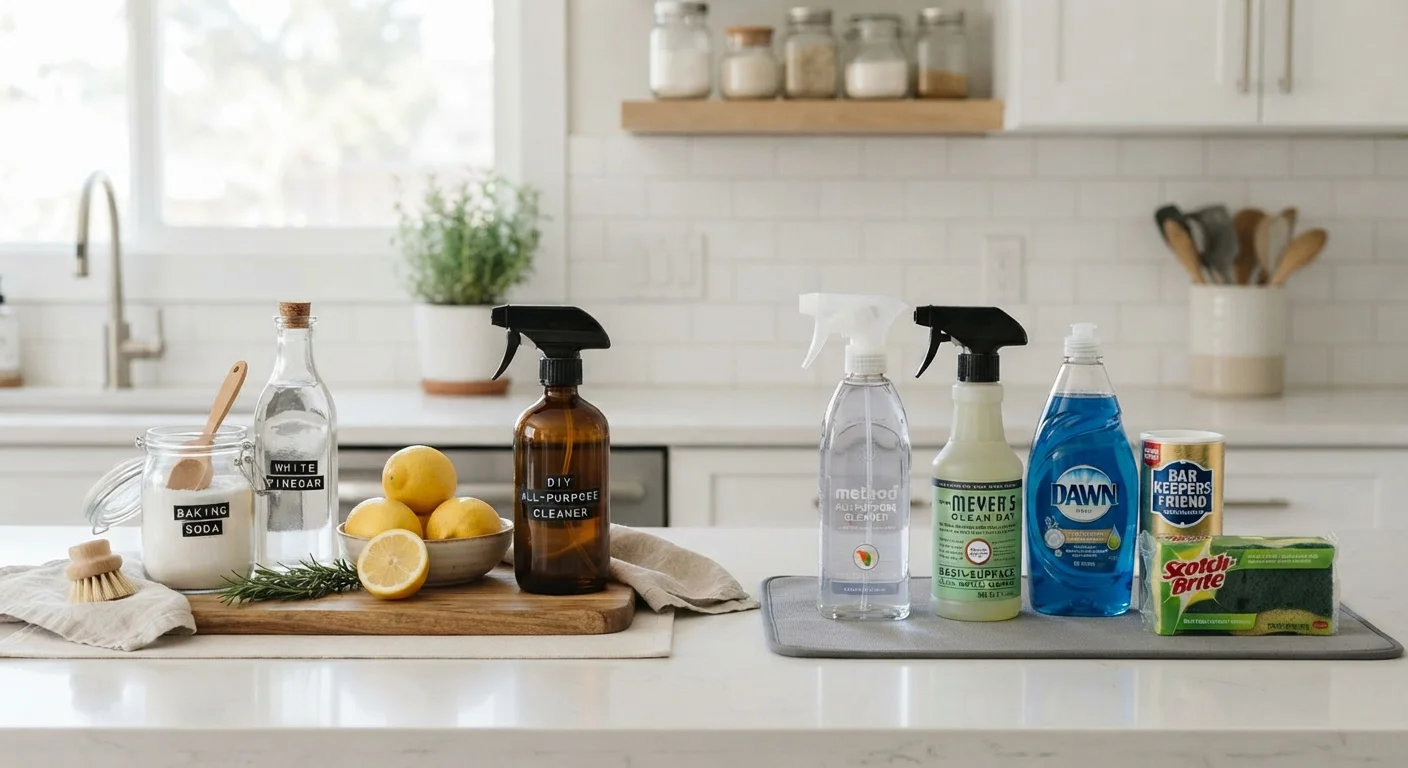
Photo: signaturehomeideas.com editorial
Key Takeaways
- Vinegar and baking soda work well for light cleaning tasks but do not disinfect in the way EPA-registered disinfectants do.
- Conventional disinfectants contain active ingredients tested to kill specific pathogens at stated concentrations.
- Mixing natural cleaners incorrectly, such as vinegar with baking soda, can cancel out their effectiveness.
- Some natural cleaners can damage natural stone, grout, and certain metals over time.
- For most households, a combination approach covers both routine and high-risk cleaning situations.
How each type of cleaner actually works
Natural cleaners rely on the chemical properties of common ingredients. White vinegar is a dilute acetic acid, effective at dissolving mineral deposits and cutting through light grease. Baking soda is a mild abrasive and a base, useful for scrubbing and deodorizing. Castile soap uses plant-derived fats to lift dirt from surfaces through basic surfactant action.
Conventional cleaners are formulated with specific active ingredients: surfactants, solvents, bleach, quaternary ammonium compounds, or hydrogen peroxide at set concentrations. These formulas are designed for predictable performance across a range of soil types. Disinfectant products in this category go through EPA registration, which requires documented evidence that they kill listed pathogens at the labeled dilution and contact time.
The practical difference comes down to consistency. Natural ingredients vary in concentration depending on how they are mixed, stored, and applied. A spray bottle of diluted vinegar may clean well or poorly depending on how much you diluted it. Conventional products state their concentrations on the label.
A note on 'non-toxic' labeling
Where natural cleaners perform well
Vinegar-based sprays handle hard water spots on faucets, glass, and chrome reliably. Baking soda removes light stains from sinks and tubs when combined with gentle scrubbing. Castile soap mixed with warm water works on most painted walls, tile, and sealed wood floors.
These options also work for odor control. Baking soda absorbs odors in refrigerators and garbage bins rather than masking them with fragrance. For households where synthetic fragrances cause sensitivities, natural cleaners provide a workable everyday alternative.
One common mistake is combining vinegar and baking soda under the assumption that two effective ingredients combine into something stronger. The acid-base reaction produces water and carbon dioxide; the result is a mostly neutralized solution that cleans less effectively than either ingredient used separately.
Where conventional cleaners outperform
Disinfection is the clearest gap. Natural ingredients like vinegar have shown antimicrobial properties in laboratory conditions, but those conditions do not replicate household use. Dwell time, surface type, soil load, and concentration all affect whether a cleaner actually kills pathogens. EPA-registered disinfectants specify the exact contact time and surface conditions required, giving you a reliable protocol rather than a rough estimate.
Mold remediation on non-porous surfaces is another area where conventional cleaners have an advantage. Diluted bleach solutions remain a standard approach for surface mold because bleach disrupts cellular structures in fungi effectively. Natural alternatives may remove the visible stain without addressing the underlying growth.
Heavy grease on stovetops and range hoods typically needs an alkaline degreaser at a higher pH than castile soap delivers. Conventional degreasers cut through built-up cooking residue faster with less scrubbing effort.
For cleaning guidance on specific rooms, see the bathroom cleaning myths article for surface-specific cautions that apply regardless of which cleaner type you use.
Surface compatibility matters more than cleaner type
Marble, granite, travertine, and other natural stone surfaces react poorly to acidic cleaners. Vinegar, lemon juice, and many conventional bathroom cleaners with acidic pH will etch the surface over time, dulling the finish. On these materials, a pH-neutral cleaner is the right choice regardless of whether it is natural or conventional.
Unsealed grout absorbs liquids readily, so both bleach-based and acidic cleaners can degrade it with repeated use. A mild soap solution applied and rinsed promptly causes less long-term damage on grout than aggressive cleaners.
Stainless steel appliances scratch with abrasive baking soda pastes if applied with coarse cloths. On these surfaces, a microfiber cloth with a small amount of dish soap cleans without scratching, natural or otherwise.
Building a cleaning schedule around your specific surfaces helps you assign the right cleaner to each task consistently rather than defaulting to one approach for everything.
This article is for informational purposes only. Always read product labels and follow manufacturer guidance for both natural and conventional cleaners. For significant mold problems or contamination concerns, consult a qualified professional.
The content provided on our blog site traverses numerous categories, offering readers valuable and practical information. Readers can use the editorial team’s research and data to gain more insights into their topics of interest. However, they are requested not to treat the articles as conclusive. The website team cannot be held responsible for differences in data or inaccuracies found across other platforms. Please also note that the site might also miss out on various schemes and offers available that the readers may find more beneficial than the ones we cover.