

Minimalist Decor vs. Maximalist Decor: Two Philosophies, One Home

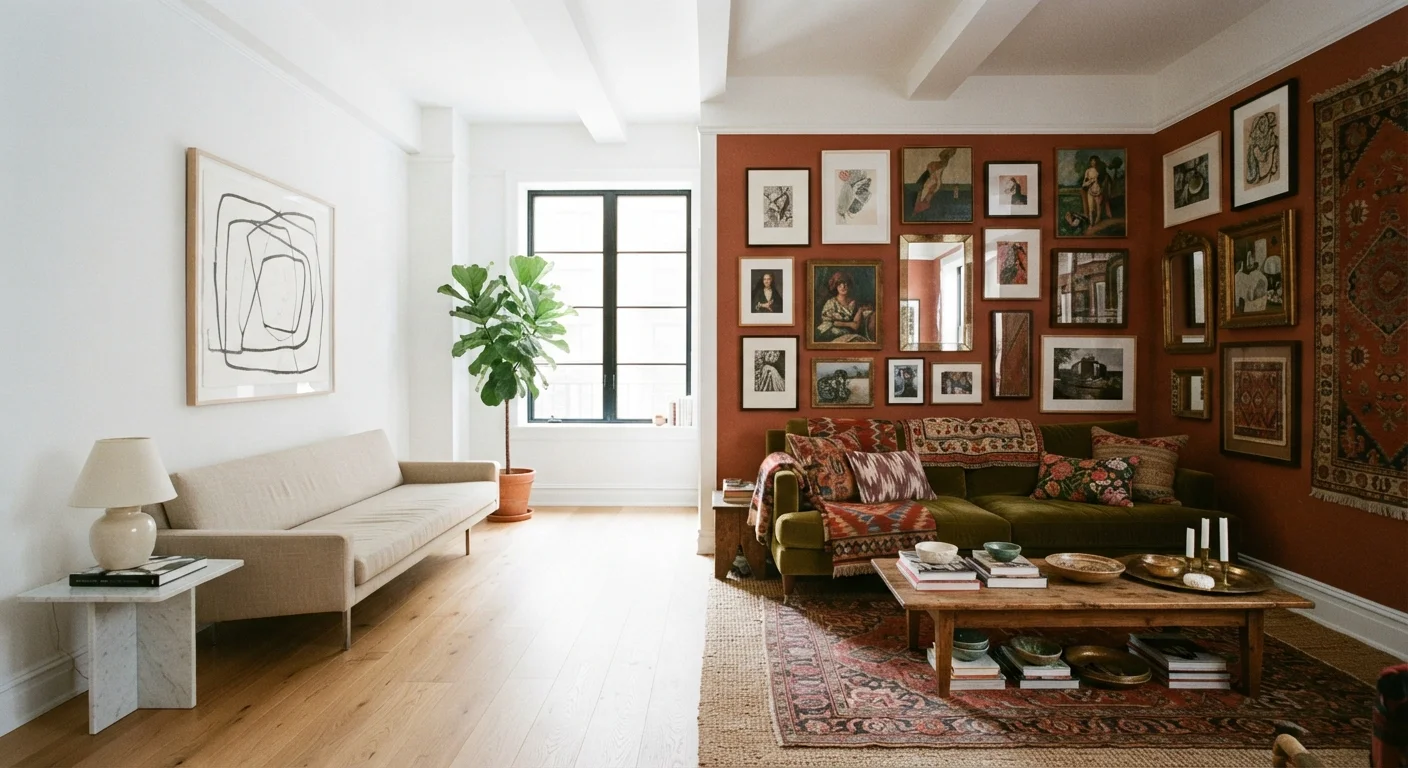
Photo: signaturehomeideas.com editorial
Key Takeaways
- Minimalism works by removing anything that does not serve a clear purpose or bring genuine calm.
- Maximalism works by building cohesion through repeated colors, textures, or themes across many objects.
- Neither style requires a large budget; both can be achieved through editing or accumulating over time.
- Small rooms do not automatically call for minimalism; thoughtful maximalism can also work with scale.
- Mixing both philosophies in different rooms of the same home is a practical and common approach.
What each philosophy actually means
Minimalist decor is built on deliberate subtraction. You keep what functions well and what you find genuinely beautiful, and you remove the rest. The result is not emptiness for its own sake; it is a room where every object has breathing room. White or neutral walls, furniture with clean lines, and a short list of decorative objects are common, but they are tools, not rules.
Maximalist decor is built on intentional addition. The goal is density and personal expression: gallery walls, layered rugs, mixed patterns, shelves full of books and objects. What separates maximalism from disorder is a unifying thread, whether that is a repeated color, a consistent era of furniture, or a clear theme running through the collection. Without that thread, the eye has nowhere to rest.
Intention matters more than style
Both styles share one requirement: intention. A minimalist room that lacks purpose reads as sparse and cold. A maximalist room without a connecting idea reads as messy. The style you choose matters less than how deliberately you apply it.
How they handle the hardest rooms
Small rooms are where these philosophies diverge most visibly. Minimalism gives a small space more perceived volume by keeping furniture low-profile and leaving floor area open. If you are already making common small-room decor mistakes, a minimalist reset can correct several problems at once.
Maximalism in a small room requires more planning, but it is not off the table. The approach shifts: you fill vertical space rather than floor space, use a single dominant color to tie many objects together, and keep large furniture to a minimum while layering smaller pieces. The room reads as curated rather than crowded when the palette stays tight.
Large, open-plan rooms present the opposite challenge. Minimalism can make them feel institutional without careful material choices: warm wood, textured linen, and natural stone give the style physical warmth. Maximalism fills large rooms naturally, but scale still matters. Oversized art and furniture anchor the space; small objects scattered across a big room without large anchors can look adrift.
| Criterion | Minimalist decor | Maximalist decor |
|---|---|---|
| Visual effect | Open, calm, spacious | Rich, layered, personal |
| Upkeep effort | Lower, fewer surfaces | Higher, more objects to clean |
| Budget pressure | Quality over quantity | Quantity can offset cost per piece |
| Small-room fit | Works well with restraint | Possible with tight palette control |
| Flexibility over time | Harder to add without disrupting | Easier to grow gradually |
| Risk of going wrong | Cold or sparse-looking | Cluttered without a unifying thread |
Practical costs and upkeep
Minimalism is often described as budget-friendly because you buy less. That is partly true, but a well-executed minimalist room puts more pressure on the quality of each individual piece, since nothing else distracts from it. A single sofa in an otherwise spare living room needs to hold up visually on its own.
Maximalism spreads that pressure across many objects. A worn vintage chair fits a layered room in ways it never could in a sparse one. Thrift stores, estate sales, and family hand-me-downs are natural sources for maximalist spaces, which makes the style genuinely accessible at low cost if you accumulate gradually.
Upkeep differs too. Minimalist rooms are faster to clean because there are fewer surfaces and objects to dust or move. Maximalist rooms take longer, but many homeowners find that maintenance easier to accept when the objects on display have personal meaning. The question is whether your daily routine supports the style you choose.
The content provided on our blog site traverses numerous categories, offering readers valuable and practical information. Readers can use the editorial team’s research and data to gain more insights into their topics of interest. However, they are requested not to treat the articles as conclusive. The website team cannot be held responsible for differences in data or inaccuracies found across other platforms. Please also note that the site might also miss out on various schemes and offers available that the readers may find more beneficial than the ones we cover.