

Quartz vs. Granite Countertops: Durability, Maintenance, and Everyday Use

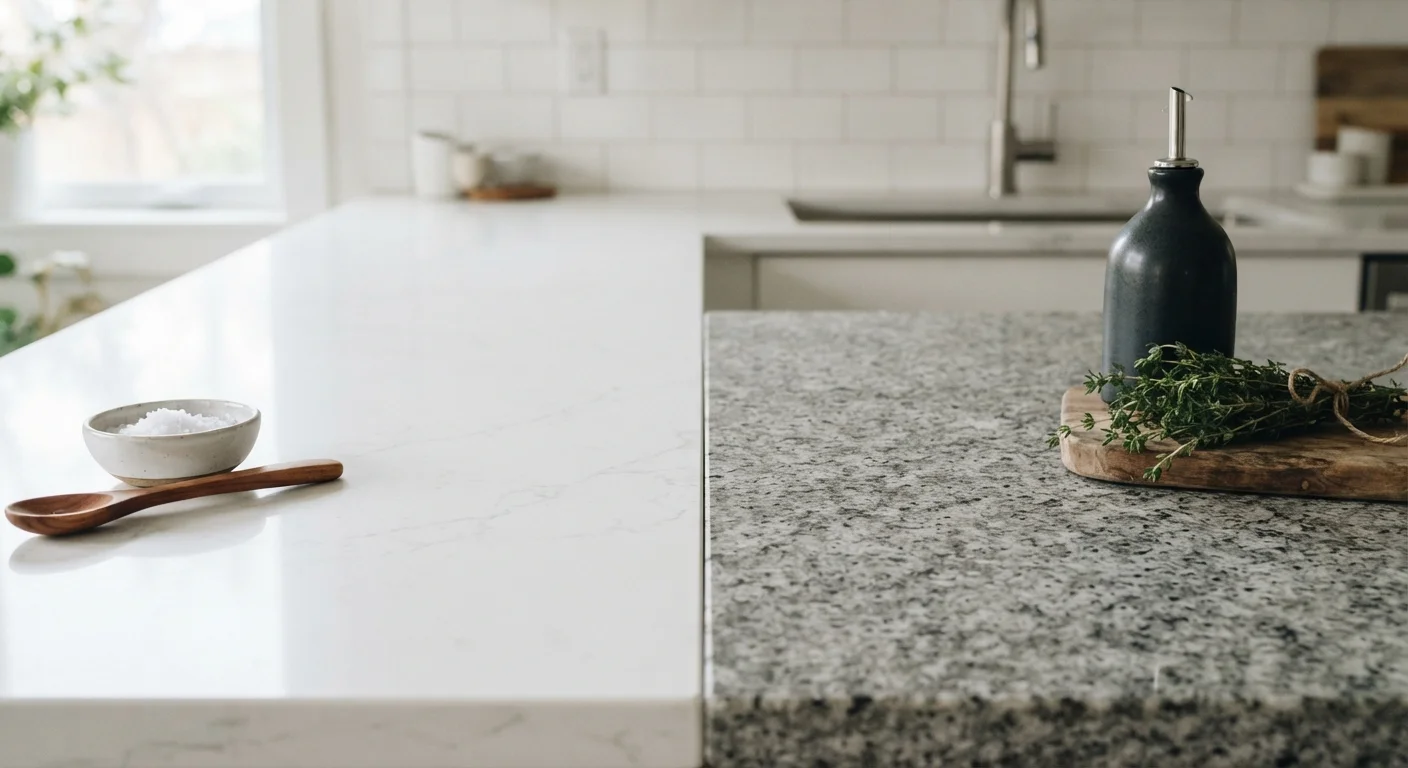
Photo: signaturehomeideas.com editorial
Key Takeaways
- Quartz is non-porous by manufacture, so it never needs sealing.
- Granite is harder than quartz but must be sealed annually to resist staining.
- Both materials handle heat differently: quartz can discolor under sustained high heat, while granite tolerates it better.
- Quartz offers consistent color and pattern; no two granite slabs look the same.
- Installation and material costs for both are comparable, varying by thickness and finish.
- Either material requires professional installation to ensure proper support and seam work.
How each material is made
Granite is a natural igneous rock quarried in large slabs, then cut and polished for countertop use. Its appearance comes directly from the mineral composition of the original stone, which varies by quarry location. Quartz countertops, by contrast, are engineered: roughly 90 to 95 percent ground quartz mineral is combined with polymer resins and pigments, then compressed into slabs. The resin binder is what makes quartz non-porous from the start.
That manufacturing difference is the root cause of most practical distinctions between the two materials. For a broader overview of how these and other materials compare, see the countertop materials reference guide.
Professional installation is standard for both
Durability and scratch resistance
Granite scores between 6 and 7 on the Mohs hardness scale, depending on its mineral composition. Quartz scores around 7. Both are hard enough that a kitchen knife will not scratch either surface under normal use, though cutting directly on stone countertops will dull knife blades quickly.
Granite is more brittle at thin edges and corners, where chips can occur from sharp impacts. Quartz handles edge impacts similarly, but the resin binder makes it slightly more flexible across the slab. Neither material is indestructible: a heavy dropped object can chip or crack both.
Heat tolerance
Granite handles heat well. A hot pan placed directly on the surface is unlikely to cause damage, though thermal shock from extreme temperature swings can, over time, stress any stone. Quartz behaves differently: the polymer resin in quartz can discolor, warp, or crack under sustained direct heat above roughly 300 degrees Fahrenheit. Using trivets under hot pots is a practical habit with either material, but it is necessary with quartz.
Maintenance requirements
| Criterion | Quartz | Granite |
|---|---|---|
| Composition | Engineered stone with resin binder | Natural quarried stone |
| Porosity | Non-porous | Porous without sealing |
| Sealing required | Never | Annually (or as needed) |
| Heat resistance | Moderate (avoid direct heat) | High |
| Scratch resistance | High (Mohs ~7) | High (Mohs 6-7) |
| Appearance consistency | Uniform across slabs | Varies between slabs |
| Stain resistance (unsealed) | High | Low |
Granite is porous, meaning liquids can penetrate the surface if left to sit. Unsealed granite can absorb oils and acidic liquids like wine or citrus juice, which leaves permanent stains. Sealing closes those pores. Most granite countertops need resealing once a year, though denser granite varieties may go longer between treatments. A simple water-bead test (pour a small amount of water on the surface and watch whether it absorbs within a few minutes) tells you when resealing is due.
Quartz needs no sealing. Daily cleaning with mild dish soap and warm water is enough for both materials. Avoid abrasive scrubbers and harsh chemical cleaners, which can dull the finish on either surface.
Appearance and variation
Granite slabs are one-of-a-kind. Color, veining, and mineral flecking vary between slabs from the same quarry, so the counter you install will not look exactly like a showroom sample. For some homeowners this is the appeal. For others it creates a matching challenge, particularly in large kitchens where multiple slabs must meet at seams.
Quartz gives manufacturers control over color and pattern. The range covers solid colors, subtle movement, and designs that mimic marble or natural stone. Consistency across slabs is far more reliable, which makes large installations and future repairs easier to match.
The content provided on our blog site traverses numerous categories, offering readers valuable and practical information. Readers can use the editorial team’s research and data to gain more insights into their topics of interest. However, they are requested not to treat the articles as conclusive. The website team cannot be held responsible for differences in data or inaccuracies found across other platforms. Please also note that the site might also miss out on various schemes and offers available that the readers may find more beneficial than the ones we cover.