

The Science Behind Why Clutter Accumulates (and What to Do About It)

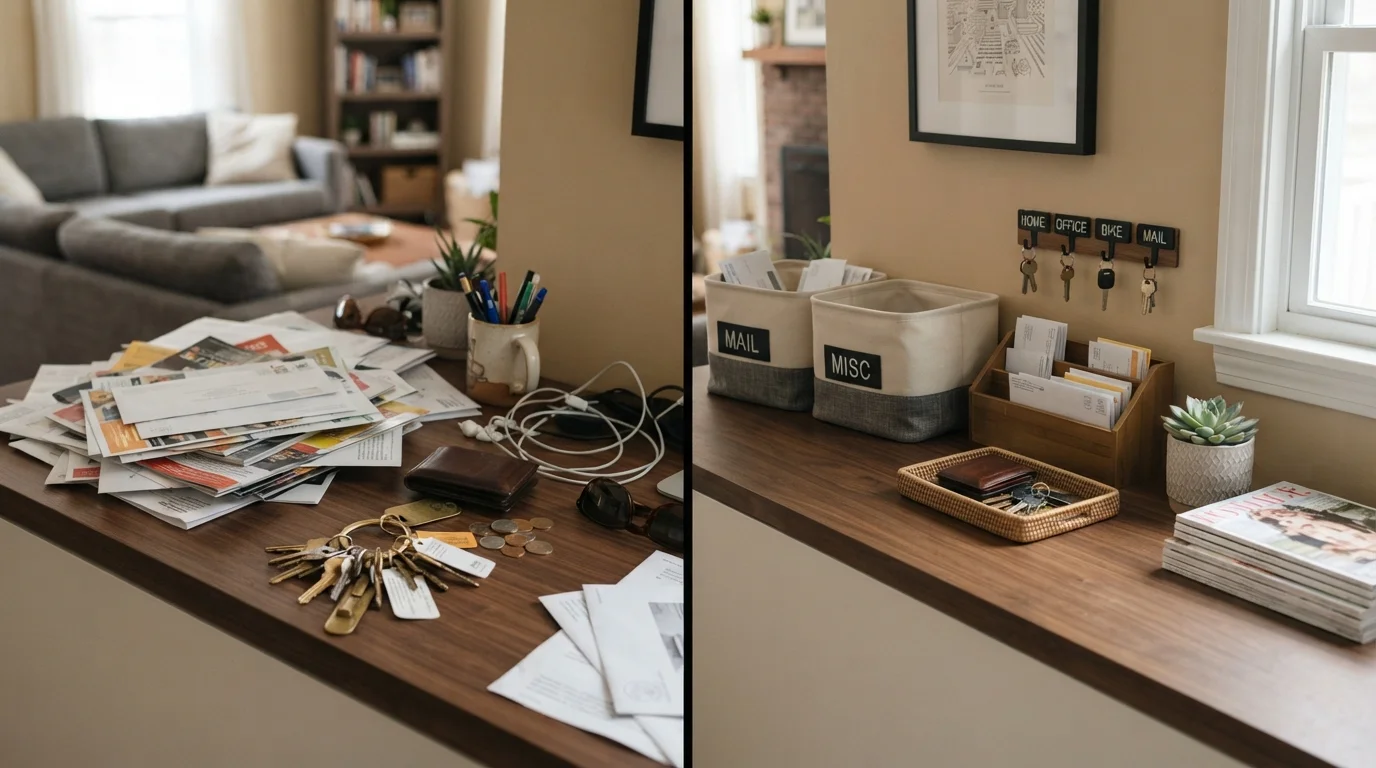
Photo: signaturehomeideas.com editorial
Key Takeaways
- Clutter builds through repeated small decisions deferred, not through single large events.
- Spaces without a defined home for objects fill up faster than those with clear storage assignments.
- Transition zones like entryways and countertops are the most common clutter hotspots in any home.
- Reducing clutter is more about systems than motivation.
- Decluttering in one area can make adjacent spaces feel more crowded if no new storage logic is introduced.
Why stuff piles up in the first place
Every object in your home arrived through a decision, but not every object stays through one. Most clutter is the result of decisions that were never made. You set the mail down because you'll deal with it later. You leave the bag by the door because putting it away takes two extra steps. Multiplied across dozens of daily interactions with objects, those deferred choices stack up fast.
This is sometimes called a 'landing zone' problem. Surfaces that are easy to reach and lack a defined function become default storage for anything that doesn't have an obvious home. Kitchen counters, entryway tables, and the first chair inside the bedroom door are classic examples. They're not cluttered because you're disorganized; they're cluttered because they're convenient and undefined.
A second driver is what researchers in decision-making call loss aversion: people tend to overestimate the cost of getting rid of something relative to the benefit of the freed space. That partly explains why objects accumulate over years. Each individual item feels too useful, too sentimental, or too uncertain to discard, even when the collective mass of those items creates real friction in daily life.
Assign a home before you buy
The spatial mechanics of clutter hotspots
Not all rooms accumulate clutter at the same rate. Transition zones, spaces you pass through rather than spend time in, collect the most. The entryway handles coats, keys, bags, and packages. The kitchen counter absorbs mail, chargers, and anything that came in from outside. These areas sit at the boundary between the outside world and your interior systems, so they catch everything that hasn't been sorted yet.
Storage mismatches make this worse. When the things you use daily don't have storage near where you use them, you leave them out. A phone charger with no drawer nearby stays on the counter. A dog leash with no hook by the door ends up on the floor. The object isn't the problem; the absence of an assigned location is.
Garage storage setups illustrate this well. Garages often become whole-home clutter sinks because they combine transition-zone dynamics (things come in and out) with a cultural assumption that the garage is where overflow belongs. Without defined zones and storage logic, the space fills floor to ceiling in no particular order.
25%
Homeowners who can't use their garage for a car
According to the U.S. Department of Energy, roughly one in four American homeowners cannot park a vehicle in their garage due to stored items.
1,000+ sq ft
Average size of self-storage unit rented per household
The Self Storage Association has reported that the U.S. has more self-storage facilities than McDonald's locations, reflecting widespread home storage overflow.
Practical strategies to interrupt the cycle
The most durable fix for chronic clutter is reducing the friction of putting things away, not increasing motivation to tidy up. When the effort to return an item to its home is lower than the effort to deal with a pile later, behavior shifts without willpower.
Start by auditing your hotspots. For each recurring pile, ask what categories of objects land there and whether storage for those categories exists nearby. If it doesn't, create it. A small wall-mounted organizer near the door handles keys and mail. A drawer divider in the kitchen gives chargers a permanent home. These are physical changes that produce behavioral ones.
For objects that accumulate because they belong to an in-between category (things to donate, things to return, things to repair), assign a single bin or box for each. When the bin is full, act on it. The bin removes the deferred decision from the surface and gives it a container with a clear endpoint.
Rooms that feel visually cramped even after tidying often have a furniture or layout issue layered on top of the clutter problem. Common decor habits that shrink a room visually are worth reviewing once your storage systems are in place, since poor spatial choices can make even an organized room feel disordered.
One last practical note: declutter in one zone before moving to another. Pulling everything out of multiple rooms simultaneously creates a temporary surge of disorder that many people abandon midway. A contained, completed zone gives you a working model to replicate elsewhere.
Clutter and mental load
Frequently Asked Questions
The content provided on our blog site traverses numerous categories, offering readers valuable and practical information. Readers can use the editorial team’s research and data to gain more insights into their topics of interest. However, they are requested not to treat the articles as conclusive. The website team cannot be held responsible for differences in data or inaccuracies found across other platforms. Please also note that the site might also miss out on various schemes and offers available that the readers may find more beneficial than the ones we cover.