

Small Closet, Big Possibilities: Organizing Tight Spaces

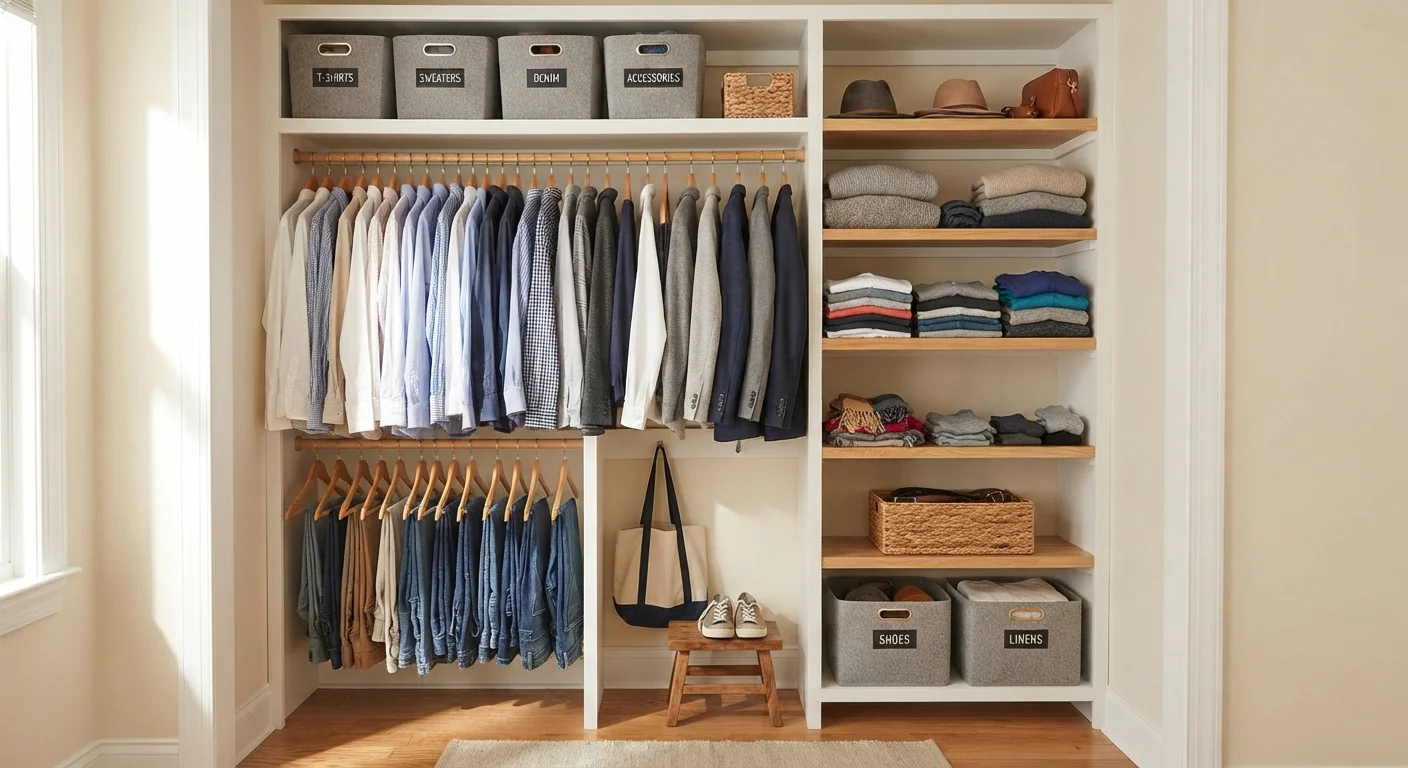
Photo: signaturehomeideas.com editorial
Key Takeaways
- Decluttering before you add any storage hardware prevents organizing a pile of things you no longer need.
- Accurate measurements of height, width, and depth are the foundation of any closet plan that actually fits.
- Double-hanging rods can nearly double usable rod length in closets that hold mostly short garments.
- Vertical space above a standard shelf is often unused and can hold seasonal or rarely accessed items.
- Consistent bin and label systems reduce the time spent searching and help the closet stay orderly.
Start with an honest audit
Before any shelf goes up or bin goes in, pull everything out and sort it into three groups: keep, relocate, and remove. This step is not optional. Organizing items you no longer use wastes the storage capacity you are trying to create.
Work through the keep pile a second time and group it by category: daily-use clothing, occasional-use clothing, accessories, shoes, and anything else that lives in the space. Those categories become your zones. Seasonal items that you access only a few times a year belong in a separate group because they should land on the highest or least accessible shelves.
Photograph your closet before you empty it
Once you know what stays and where it roughly belongs, you have enough information to make real decisions about shelving, rods, and bins.
Measure before you plan
Measure the interior width, height, and depth of the closet at multiple points. Walls are rarely perfectly square, and a shelf cut a quarter-inch too wide will not slide in. Record the height from floor to ceiling, from floor to the existing rod if one is present, and the depth at the front and back of the space.
Closet depth affects what fits
Sketch the closet to scale on paper or use a free room-layout tool. Mark where the door swings, any light fixtures, and existing brackets or rods you plan to keep. This sketch prevents buying hardware that cannot physically fit.
Also measure the items you need to store. Long coats need at least 60 inches of vertical clearance. Folded shirts on shelves need far less. Knowing those dimensions tells you exactly how tall each zone needs to be before you commit to any layout.
Shelving layouts that work in tight spaces
A single shelf near the top of a closet, paired with one rod below it, leaves a large amount of vertical space unused above the shelf and often a dead zone near the floor. A better layout stacks shelves at intervals that match your actual items.
For a reach-in closet, consider this sequence from top to bottom: a high shelf (65 to 70 inches from the floor) for bins and seasonal goods, a mid-height zone with adjustable shelves for folded items or a double-hang rod, and a low section or floor area for shoes or a small freestanding drawer unit. Adjustable shelving lets you shift heights later without reinstalling brackets.
Check wall material before anchoring hardware
If your closet has only one wall and limited width, a corner shelf configuration is rarely worth the complexity. Keep the layout simple so every item has a clear, reachable home.
See how vertical space can be used across every room for more ideas that apply beyond the closet.
Hanging strategies that recover dead space
A double-hang rod setup is one of the most direct ways to increase capacity. Install the primary rod at the standard height of about 66 to 68 inches, then add a second rod at roughly 40 inches below it. Short garments, folded pants on clamp hangers, and jackets fit in the upper tier; shirts and folded trousers work in the lower tier. The floor beneath the lower rod becomes accessible for a shoe rack or a small bin.
Over-the-door organizers add storage without using any wall space. Clear-pocket versions work well for accessories, small folded items, or cleaning supplies in utility closets. Check that the organizer's total depth does not prevent the door from closing fully before purchasing.
Slim-profile hangers replace bulky plastic ones and can recover two to three inches of rod space in a tightly packed closet. That small change often makes the difference between garments that hang freely and a rod so packed that finding anything requires effort.
Drawer and bin solutions for folded items
Open shelves work for items you reach for every day. For folded garments, accessories, and small loose items, bins and drawers prevent things from spreading across the shelf and collapsing into each other.
Clear bins let you see contents without labeling. Opaque bins need a label on the front edge, and a label on the bin rather than the lid means you can read it without pulling the bin down. Consistent bin sizes stack cleanly and look orderly, which makes it easier to spot when something is out of place.
Dead space
Areas inside a closet that hold no items because they are awkwardly positioned or too high to reach easily. Common examples include the gap above a single shelf and the floor area beneath hanging clothes.
Double-hang rod
A second horizontal rod installed below the primary rod, creating two tiers of hanging space. It works best where garments are short enough that two tiers fit without touching.
Adjustable shelving
A shelf system mounted on tracks or pegs that let you reposition shelf heights without reinstalling brackets. This makes it easy to reconfigure as your storage needs change.
Declutter
Removing items you no longer use, need, or want before organizing what remains. Decluttering is a separate step from organizing and should come first.
Zone
A dedicated area within a storage space assigned to one category of items. Zones reduce searching by giving every category a fixed, predictable home.
Freestanding drawer units sized to your shelf depth can slot into the lower zone of a reach-in closet and hold the equivalent of a small dresser. This is useful in bedrooms where floor space is too limited for a separate furniture piece. For more on furniture that doubles its function in small spaces, see what multi-functional furniture actually delivers.
Maintaining the system over time
A closet organization system works as long as every item returns to its assigned zone after use. The most common reason a freshly organized closet reverts to disorder within a month is that there is no clear home for new items when they arrive.
Run a brief edit two to four times a year, ideally when seasons change. Pull anything that no longer fits, is worn out, or belongs elsewhere. A seasonal rotation system formalizes this habit and prevents the closet from gradually filling with items that have no business being there.
If the closet consistently overflows despite organizing, the problem is volume, not layout. Relocating less-used items to another storage area, such as the approach covered in a structured garage storage plan, often resolves the pressure better than adding more hardware to an already full space.
Frequently Asked Questions
The content provided on our blog site traverses numerous categories, offering readers valuable and practical information. Readers can use the editorial team’s research and data to gain more insights into their topics of interest. However, they are requested not to treat the articles as conclusive. The website team cannot be held responsible for differences in data or inaccuracies found across other platforms. Please also note that the site might also miss out on various schemes and offers available that the readers may find more beneficial than the ones we cover.