

Layered Lighting: The Three-Layer Approach That Transforms Any Room

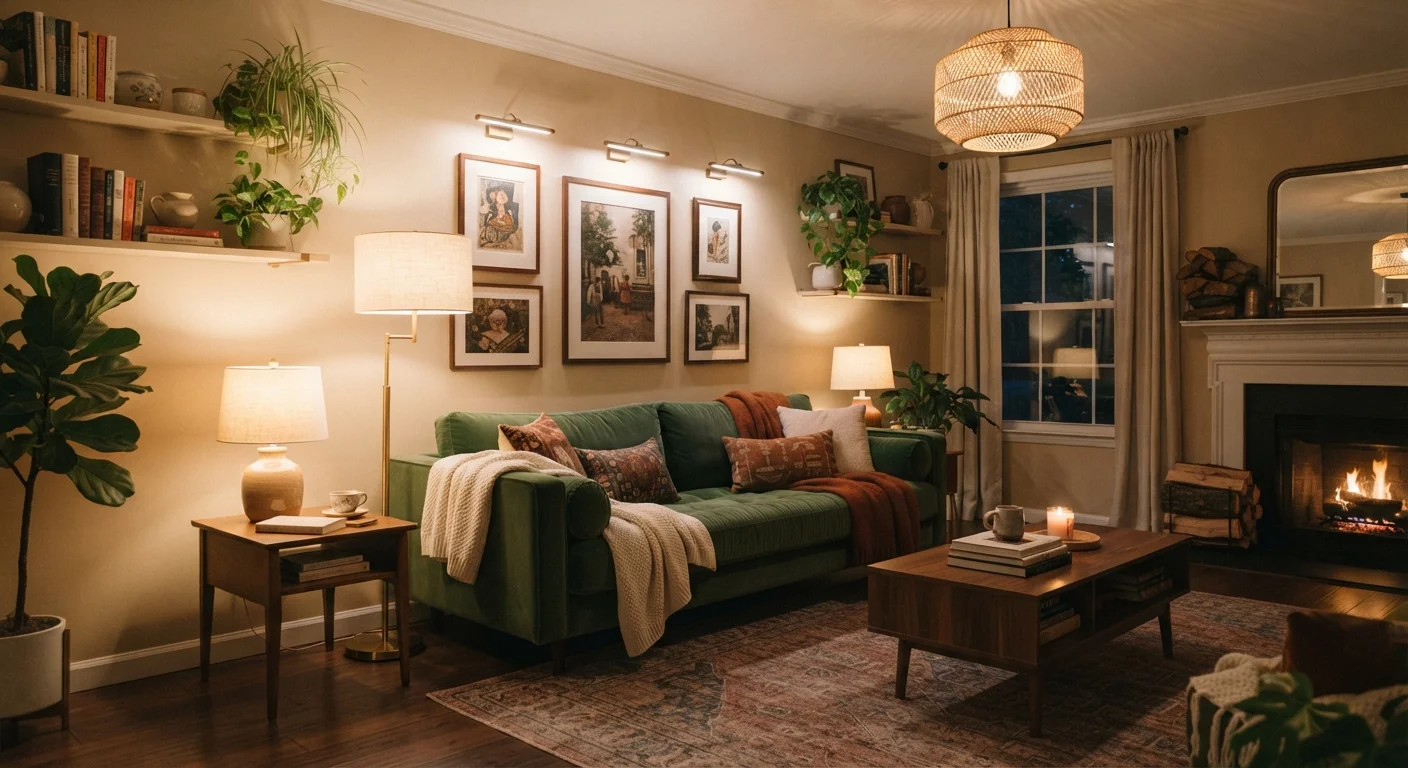
Photo: signaturehomeideas.com editorial
Key Takeaways
- A single overhead fixture cannot do everything a room needs from its lighting.
- Ambient, task, and accent lighting each serve a distinct purpose and work best in combination.
- Dimmer switches let you shift the balance between layers without adding new fixtures.
- The right bulb color temperature affects how each layer feels in the room.
- Most lighting problems in a home trace back to relying on only one layer.
What layered lighting actually means
Most rooms in a home rely on one overhead fixture for all their light. That approach works in the sense that people can see, but it creates flat, shadowless light that feels institutional. Layered lighting is the practice of using three distinct types of light sources together so the room can serve multiple functions and feel comfortable at different times of day.
The three layers are ambient, task, and accent. Each targets a different need. Ambient light fills the space so you can navigate it safely. Task light focuses where you are working or reading. Accent light draws attention to something worth seeing. A room with all three gives you control over the mood and function of the space in a way a single ceiling fixture never can.
If your living room always feels too dim in the evening or too glaring during the day, layering is usually the solution. See why living rooms feel too dark or too harsh for a closer look at the specific culprits.
Ambient lighting
The general, overall light in a room that lets you move around safely and see the whole space. It is the base layer of any lighting plan.
Task lighting
Focused light aimed at a specific area where you do a particular activity, such as reading, cooking, or applying makeup.
Accent lighting
Directional light used to draw attention to an object, texture, or architectural feature, such as a painting, bookshelf, or fireplace.
Color temperature
A measurement (in Kelvin) of how warm or cool a light source appears. Lower numbers (2700K) produce warm yellowish light; higher numbers (5000K+) produce cool bluish-white light.
Dimmer switch
A wall control that adjusts the brightness of a light fixture. It lets you change the mood of a room without replacing bulbs or fixtures.
Foot-candle
A unit that measures how much light actually reaches a surface. Task areas generally need more foot-candles than ambient spaces.
Ambient lighting: the base layer
Ambient light is the general fill that lets a room function at a basic level. In most homes it comes from a ceiling-mounted fixture, recessed downlights, or a ceiling fan with a light kit. The goal is even, low-glare coverage across the whole floor area.
The common mistake is setting ambient light too bright. When the overhead fixture is the only source and it runs at full power, everything looks flat and every shadow is harsh. A dimmer switch changes this immediately. Lowering ambient light in the evening and letting task lamps do the detail work creates a far more comfortable balance.
Color temperature also affects how ambient light feels. A bulb in the 2700K to 3000K range produces warm white light that reads as relaxed in a living room or bedroom. A kitchen or bathroom may tolerate a slightly cooler 3000K to 3500K without feeling clinical.
Electrical work requires a licensed professional
Task lighting: light where you work
Task lighting aims at the surface or area where you are doing something specific. A reading lamp beside a chair, a pendant above a kitchen island, and a lighted mirror in a bathroom vanity are all task lights. The shared requirement is that the light be bright enough and positioned so it does not create glare or cast a shadow across the work surface.
In kitchens, under-cabinet fixtures address the biggest task lighting gap: overhead ambient light from behind you casts your own shadow onto the counter. Under-cabinet lighting types and placement covers the options in detail, including plug-in strips that require no electrical work.
For reading, a lamp positioned so the bottom of the shade falls roughly at shoulder height when you are seated will direct light onto the page without shining into your eyes. Adjust this to your own chair height rather than following a fixed measurement.
Start with lamps before committing to fixtures
Accent lighting: shaping depth and interest
Accent lighting does not illuminate a room for function. Its job is to create contrast, draw the eye to something specific, and give the space visual depth. A recessed adjustable downlight aimed at a painting, a small uplight behind a large plant, and picture lights mounted above framed art are all accent fixtures.
The general guideline is that accent light should be three to five times brighter than the ambient light in that area of the room. If ambient light is set low and an accent fixture hits a textured wall or bookshelf at higher intensity, the wall appears to have dimension that flat overhead light would erase.
Accent lighting also interacts with paint and surface colors in ways ambient light does not. How hues shape a space goes deeper on how warm and cool light sources change the perceived color of walls and finishes.
Putting all three layers together
A practical way to build a layered plan is to start with what you already have and identify the gaps. Most rooms already have ambient light. Ask whether there are surfaces where you struggle to see clearly (a task gap) or whether the room feels uniformly flat and uninteresting (an accent gap).
In a dining room, the most common problem is a single pendant centered on the table with no other sources. Adding a buffet lamp or wall sconces introduces an ambient alternative and lets the pendant become an accent as much as a task light. Dining room lighting mistakes details how a mis-sized or mis-placed fixture undermines an otherwise well-arranged room.
Control matters as much as placement. Separate switches or dimmers for each layer mean you can run task lights at full power while ambient light dims, or bring accent lights up in the evening when you want the room to feel more deliberate. That flexibility is what separates a layered plan from a collection of fixtures that happen to share a room.
This article is for informational purposes only. Electrical work should be performed by a licensed electrician. Always check local building codes and permit requirements before modifying any electrical system in your home.
Frequently Asked Questions
The content provided on our blog site traverses numerous categories, offering readers valuable and practical information. Readers can use the editorial team’s research and data to gain more insights into their topics of interest. However, they are requested not to treat the articles as conclusive. The website team cannot be held responsible for differences in data or inaccuracies found across other platforms. Please also note that the site might also miss out on various schemes and offers available that the readers may find more beneficial than the ones we cover.