

Outdoor Lighting That Actually Works: Safety, Ambiance, and Energy Efficiency

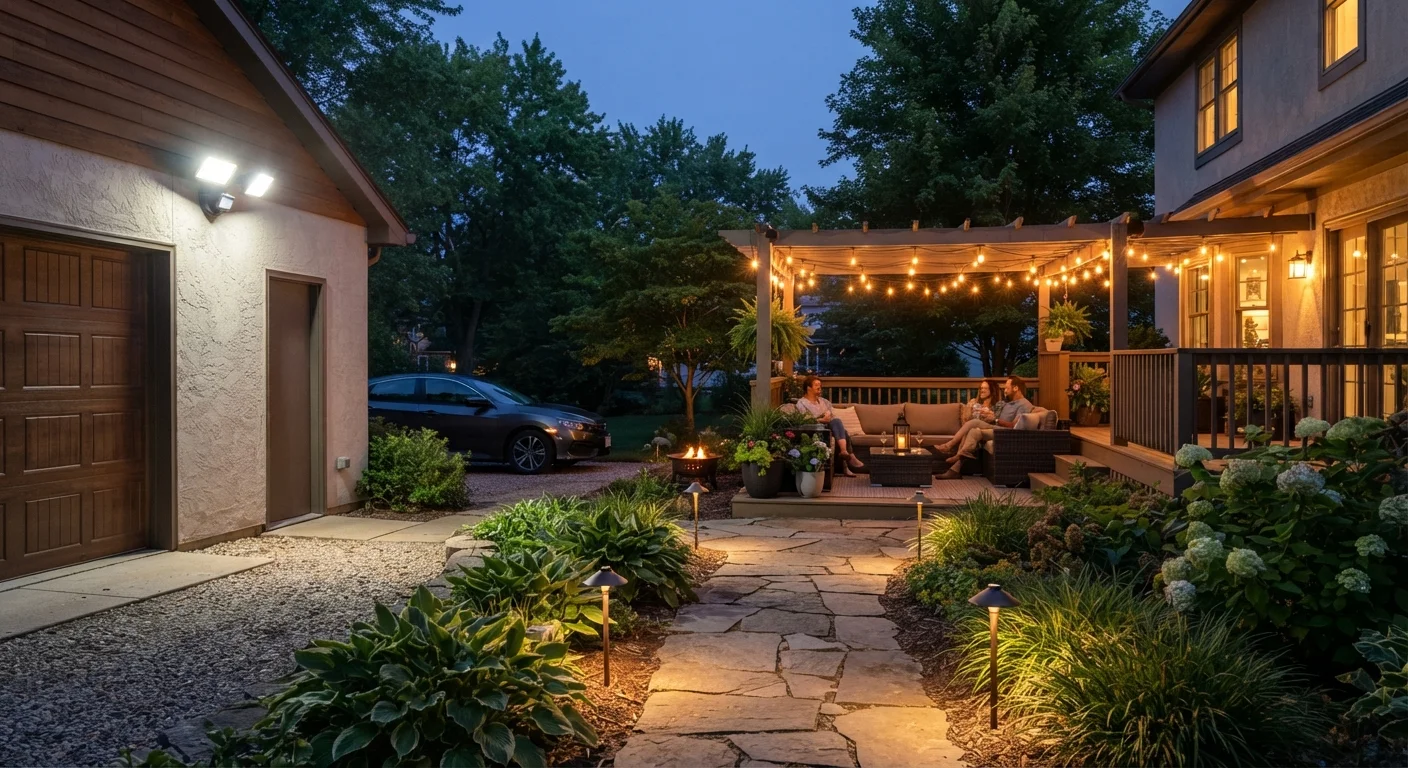
Photo: signaturehomeideas.com editorial
Key Takeaways
- Treat outdoor lighting as a system with distinct zones: entry, pathways, and living areas each have different requirements.
- Motion-activated and photocell fixtures reduce energy use without sacrificing security.
- LED fixtures rated for outdoor use (UL wet or damp listed) last significantly longer than incandescent alternatives.
- Any new outdoor circuit or fixture added to an existing circuit requires a permit in most U.S. jurisdictions.
- Low-voltage landscape lighting is a realistic DIY project; line-voltage work should involve a licensed electrician.
Outdoor lighting as a system
Outdoor lighting has three jobs: keeping people safe on your property, extending the usability of outdoor spaces after dark, and doing both without running up your electricity bill. Most homeowners address these goals one fixture at a time, which leads to dark spots next to overlit areas and inconsistent results.
A more reliable approach treats the yard as a set of zones, each with its own purpose. Entry points and pathways need enough light to prevent trips and falls. Living areas such as patios and decks benefit from softer, directional light that does not wash out the space. Security-focused zones around garage doors, side gates, and dark corners need brightness that activates when it matters. This zoning logic mirrors the layered indoor approach described in our guide to layered lighting.
Security and safety lighting
Motion-activated floodlights are the standard for security zones. A fixture with a passive infrared (PIR) sensor detects heat movement and switches on for an adjustable period, typically 1 to 5 minutes. Because the light is off most of the time, energy consumption stays low even with a bright bulb.
Placement matters more than wattage. Mount floodlights 8 to 10 feet above the ground, angled so the sensor covers the approach path rather than pointing at a wall. A fixture aimed poorly will either miss moving objects or trigger constantly on street traffic.
Pathway lights serve a safety function too, but their goal is illuminating the walking surface rather than detecting intruders. Stake-style fixtures spaced 6 to 8 feet apart along a path provide enough contrast for someone to see footing clearly without creating a runway effect.
Outdoor outlets must be GFCI-protected
Ambiance and outdoor living zones
A patio or deck used for dining or conversation calls for warm, low-glare light in the 2700K to 3000K color temperature range. (Color temperature, measured in Kelvin, describes how warm or cool white light appears. Lower numbers are warmer and more amber-toned.) String lights, recessed soffit fixtures, and wall sconces all work here. The goal is enough light to see faces and food without harsh shadows or light that spills into neighbors' yards.
Downlighting from a tree or overhead structure creates a soft, diffuse effect that most people find comfortable. Uplighting on a single architectural feature or plant, when kept to a narrow beam angle, adds interest without competing with functional zones. For homeowners planning larger landscape changes, landscape planning from scratch covers how to think about sight lines before fixtures go in the ground.
Choosing energy-efficient fixtures
LED fixtures have replaced incandescent and halogen options as the practical standard for outdoor use. They consume roughly 75 percent less energy for equivalent light output and last far longer in cycling conditions, such as motion-activated floodlights that switch on and off frequently.
When selecting fixtures, look for two ratings. First, the IP (Ingress Protection) or UL wet/damp listing tells you what weather exposure the fixture can handle. Wet-listed fixtures work anywhere exposed to direct rain; damp-listed fixtures are suitable for covered porches. Second, lumens tell you how much light a fixture produces. A pathway light typically needs 100 to 200 lumens; a security floodlight commonly runs 700 to 1,300 lumens.
Photocell controls automatically turn fixtures off at sunrise, preventing the common waste of lights running through daylight hours. Some fixtures combine a photocell with motion sensing, so the fixture dims to a low standby level at night and brightens only when movement is detected. Smart lighting systems can extend this control further, though they add setup complexity worth understanding before you commit.
Installation and code considerations
Low-voltage landscape lighting systems, which operate at 12 volts through a plug-in transformer, are a reasonable DIY project for most homeowners. The transformer plugs into a standard outdoor outlet, and cable runs can be buried a few inches below the surface or pinned under mulch.
Line-voltage work is a different category. Adding a new outdoor outlet, running conduit, or installing a hard-wired fixture on a new circuit involves working with 120-volt wiring and typically requires a permit and inspection. In most U.S. jurisdictions, that work must be done by or inspected alongside a licensed electrician. Check with your local building department before starting, because requirements vary by municipality. Common lighting myths covers some of the misconceptions that lead homeowners into unsafe shortcuts.
This article provides general educational information about outdoor lighting. It is not a substitute for professional electrical advice. Always verify local permit and code requirements before beginning any electrical work on your home.
The content provided on our blog site traverses numerous categories, offering readers valuable and practical information. Readers can use the editorial team’s research and data to gain more insights into their topics of interest. However, they are requested not to treat the articles as conclusive. The website team cannot be held responsible for differences in data or inaccuracies found across other platforms. Please also note that the site might also miss out on various schemes and offers available that the readers may find more beneficial than the ones we cover.